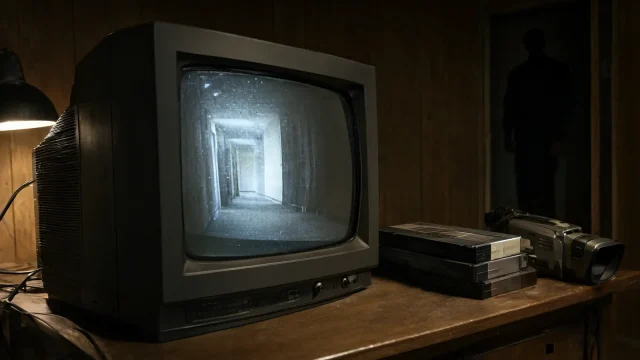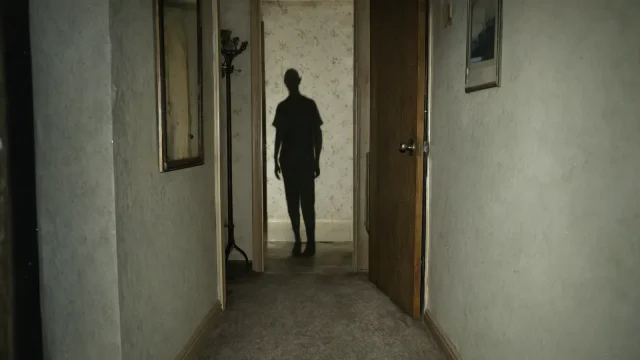
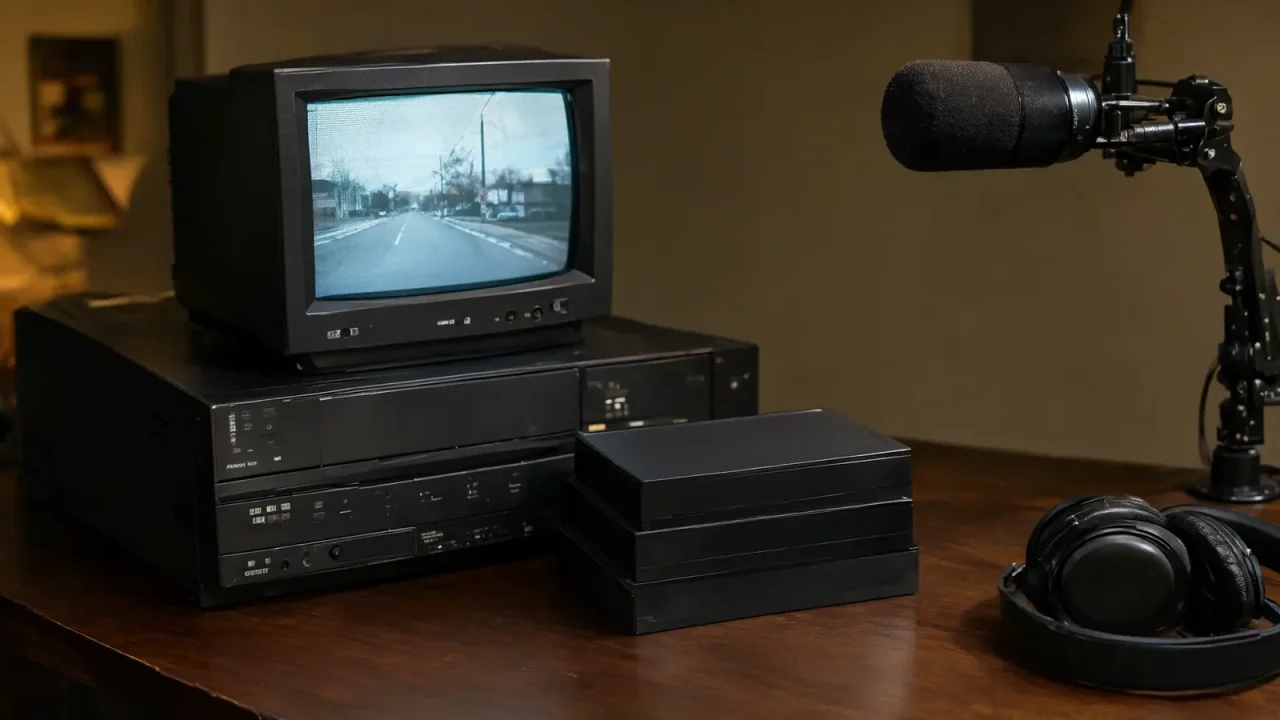
Anyone studying how to make analog horror discovers fast that static overlays alone never create dread. Rooted mainly on YouTube as an offshoot of found-footage film and creepypasta, this subgenre favors low-fidelity graphics, cryptic text, minimal traditional jump scares, and 1960s–2000s broadcast styles.
Its lineage explains why solo creators thrive. Faux-live dramas—from Orson Welles’s 1938 The War of the Worlds radio broadcast to television movies like Ghostwatch (1992), Special Bulletin (1983), and Without Warning (1994)—proved broadcast authority makes fiction feel urgent. Found-footage hits such as Paranormal Activity (2007), Ring (1998), and The Blair Witch Project (1999) collided with haunted-media creepypastas (Ben Drowned, NES Godzilla Creepypasta, and Kris Straub’s 2009 Candle Cove), leading to web landmarks: Steven Chamberlain’s No Through Road (January 2009), Poland’s Kraina Grzybów TV (December 2013), and Straub’s Local 58 (October 2015), whose motto “ANALOG HORROR AT 476 MHz” named the genre.
Follow-ups model varied toolkits: Gemini Home Entertainment (2019) hides cosmic dread inside educational tapes; The Mandela Catalogue (2021) edits still portraits and vintage cartoons; and Kane Pixels’ Backrooms (2022) disguises Blender 3D and Adobe After Effects shots beneath VHS wear. Theatrical features like Skinamarink (2022), Late Night with the Devil (2023), Buddy (2026), and A24’s Backrooms (2026), plus Netflix’s 2022 series adapted from the 2016 podcast Archive 81, confirm that tight budgets scale when the concept holds.
Story Design and In-World Camera Framing
Scholar David Bordwell calls fictional recovered recordings “discovered footage,” while San Francisco’s Unnamed Footage Festival uses “in-world camera” for stories whose recording hardware exists inside the plot. In a 2016 Cinema Journal study, Cecilia Sayad noted that timestamps, fixed angles, and tight framing unsettle viewers who scan frame margins expecting unseen threats.
- Pick a mundane host format: Frame your video as an ordinary training reel, station bumper, safety film, or family tape so the first subtle deviation hits sharply.
- Let limits conceal threats: Soft resolution, dim flash lighting, and muffled audio force audiences to imagine what hides in dark corners.
- Respect era hardware: Match graphics to your fictional date—US Emergency Alert System banners did not launch until January 1, 1997.
Authentic VHS Specifications and Visual Degradation
Beginner edits fail when heavy static sits atop crisp digital video. Launched by JVC on September 9, 1976 (reaching America via RCA’s VBT200 on August 23, 1977), VHS recorded onto 12.7 mm metal-oxide Mylar tape and ruled home video across the 1980s and 1990s until DVD passed US rentals in 2003 and hardware ended in 2016. Respecting real IEC 60774-1 bottlenecks—especially sharp luminance versus smeared color—sells the illusion.
| Standard | Luma / Resolution | Chroma Bandwidth | Drum & Tape Speed | Best In-World Role |
|---|---|---|---|---|
| NTSC VHS (SP) | 240 TVL (~333×480 luma, 525 lines) | 300 kHz (~40×480 chroma) | 1,798.2 RPM (1/60 s); 3.335 cm/s | North American 1980s–1990s home tapes and PSAs |
| PAL VHS (SP) | 240 TVL (~333×576 luma, 625 lines) | 300 kHz (~40×576 chroma) | 1,500 RPM (1/50 s); 2.339 cm/s | European or Australian archival broadcasts |
| VHS LP / EP (SLP) | Drops from ~250 to 230 lines or fewer | Narrow tracks, extra noise | Slower linear tape degrades audio | Long surveillance dubs or worn multi-copy tapes |
| Super VHS (1987) | 420 TVL (>5 MHz bandwidth) | Cleaner luminance separation | Higher-grade institutional playback | Local station masters or training reels |
Because VHS gives black-and-white luma 3 MHz (~333×480 NTSC pixels) yet caps chroma at 300 kHz (~40×480), genuine tapes preserve readable white titles while colors bleed horizontally. Authentic flaws also stem from oxide dust dropouts, narrow EP/SLP tracking wobble, and Macrovision copy-protection pulses causing brightness swings or Level II/III “colorstriping” bands.
Crafting Broadcast Alerts, Uncanny Faces, and Analog Voices
Making analog horror videos believable demands disciplined craft across three recurring building blocks.
EAS Structure and FCC Legal Boundaries
Approved in November 1994 by the FCC and active since January 1, 1997 (replacing EBS), the US Emergency Alert System runs jointly under FEMA, the FCC, and NOAA. Real alerts have four parts: three redundant SAME (Specific Area Message Encoding) digital headers, an 8–25 second attention tone (commercial dual sine waves at 853 Hz and 960 Hz creating a jarring near-major-second clash), a spoken or text notice, and three AFSK End-of-Message bursts encoding “NNNN.”
Real false alarms—the February 2013 Montana/Michigan encoder hack via default passwords announcing a “zombie apocalypse,” Hawaii’s 38-minute false missile alert on January 13, 2018, and the viral August 21, 2024 Indonesian EAS protest clip—show why alert banners spark immediate dread. Heed one strict legal boundary: airing genuine EAS attention tones or SAME headers on television or radio outside real emergencies or authorized PSAs violates FCC rules and draws fines. Even playing a recording of the 2013 hoax accidentally tripped Wisconsin station WKBT-DT’s live EAS decoder. Synthesize custom fictional tones for online uploads rather than sampling live SAME bursts.
Designing Uncanny Faces and Distorted Images
Learning how to make analog horror faces unsettle viewers depends on disciplined restraint grounded in perceptual psychology. Robotics professor Masahiro Mori introduced the concept in 1970 in his essay Bukimi no Tani, which writer Jasia Reichardt translated as the uncanny valley in her 1978 book Robots: Fact, Fiction, and Prediction. Mori observed that near-human likeness triggers sharp revulsion when subtle flaws break empathy—a response researchers at the University of California, San Diego studied through brain-activation scans in 2011 and psychologists Alexander Diel and Michael Lewis extended to liminal architecture in 2022.
Early photorealistic cinema demonstrated the exact failure points analog horror creators deliberately harness. When Final Fantasy: The Spirits Within debuted in 2001, The Guardian critic Peter Bradshaw noted that near-real digital faces felt phony because they stopped just short of full human lifelikeness, while Rolling Stone reviewer Peter Travers pointed to coldness in the eyes and mechanical motion. Similarly, after critics described The Polar Express (2004) as eerie and dead-eyed, animation director Ward Jenkins documented how slight shifts around the eyes and eyebrows separate lifelike warmth from lifeless stillness. Apply that same principle to portrait edits: mild facial asymmetry, frozen gaze lines, harsh flash falloff, and shadowed eye sockets unsettle viewers far better than overt gore—examine how Alternates in The Mandela Catalogue rely on shadow and subtle facial decay. Always match VHS chroma blur, grain texture, and lifted black floors across composited layers so altered faces stay embedded inside the tape signal.
Building Vintage Voices and Broadcast Audio
When shaping how to make analog horror voice tracks sound period-true, remember linear VHS heads read slow-moving tape, curbing crisp highs in LP/EP modes. Process narration or synthetic speech with band-pass EQ, gentle compression, soft noise floors, and unhurried pauses.
Free Production Tools for Desktop and Mobile
Two verified free suites cover how to make analog horror from blank script to final upload:
- Blender (3D Sets, Sculpting & Retro Graphics — Free / GNU GPLv2+): Started by Ton Roosendaal at NeoGeo in January 1994 and open-sourced via the Blender Foundation in 2002 for Windows, macOS, and Linux, Blender builds empty rooms and strange figures via Geometry Nodes (added in 2.92; fields in 3.0), dynamic-topology sculpting, shape keys, Mantaflow haze, and 2D Grease Pencil drawing inside 3D scenes. Since version 2.80, it includes Cycles (CPU/GPU path tracing via CUDA or OptiX), EEVEE (real-time PBR upgraded in 4.2 LTS in July 2024 with SSGI and virtual shadowmapping), and Workbench previews.
- DaVinci Resolve (Edit, VFX, Color & Audio — free desktop edition): Blackmagic Design’s suite for Windows, macOS, and Linux splits work into Media, Cut, Edit, Fusion, Color, Fairlight, and Deliver pages. Its free tier outputs up to 4K at 60 FPS across MP4, QuickTime, AVI, WAVE, and AAC (paid Studio adds 32K, 120 FPS, AI tools, and OpenFX like Face Tracking or Lens Flare). Integrated Fusion (since version 15 in 2018) handles node-based chroma smear and tracking roll, while Fairlight (since version 14 in 2017) mixes up to 1,000 tracks—supporting up to 24 aux-sends and 6 inserts per track—with parametric EQ, compression/expansion, limiting, gating, and VST/AU plugins.
- Mobile Option (DaVinci Resolve for iPad): Creators exploring how to make analog horror on mobile tablets can run free DaVinci Resolve for iPad (launched December 2022 for iPads powered by Apple’s A12 Bionic processor or newer on iPadOS 16+). It shares desktop-compatible project files for cutting and retro color grading, leaving heavy node VFX to desktop computers.
Step-by-Step Production Checklist From Concept to Upload
- Lock the Artifact: Define the recording agency, exact decade, deck format, and normal purpose before scripting.
- Pace quiet escalation: Open with mundane call signs or steady pans before introducing one contradictory clue.
- Capture Clean Assets: Shoot dim rooms or render bare Blender sets via EEVEE or Cycles cleanly first.
- Apply True Tape Wear: In Resolve’s Fusion and Color pages, frame in 4:3, blur chroma harder than luma to mirror VHS’s 300 kHz ceiling, and save heavy dropouts for reveals.
- Mix Period Audio in Fairlight: Trim vocal extremes with parametric EQ, add subtle tape hiss, tame peaks via limiting, and keep fictional alert tones distinct from real EAS broadcasts.
- Test in Darkness & Deliver: Check readability on dark desktop and phone screens, then export an MP4 master.
Frequently Asked Questions
What free software works best to start making analog horror?
DaVinci Resolve’s free edition combines editing, Fusion node compositing for VHS wear, CRT color grading, and Fairlight audio mixing in one app. Combining DaVinci Resolve with free, open-source Blender lets solo creators build 3D spaces and uncanny figures at zero software cost.
How do you make VHS effects look authentic instead of fake?
Mirror physical VHS limits instead of dumping heavy static over sharp video. NTSC VHS holds roughly 240 TVL (~333×480 luma) yet squeezes color to 300 kHz (~40×480 chroma), keeping white lettering legible while smearing color horizontally with mild tracking drift.
Is it legal to use real Emergency Alert System (EAS) sounds in YouTube horror videos?
FCC rules bar airing genuine EAS attention tones or SAME headers on television or radio outside real emergencies or authorized PSAs, carrying fines, and recorded clips have tripped live station decoders. Synthesize clearly fictional tones for online videos rather than copying real SAME signals.
Can you make analog horror on mobile or a tablet?
Yes. Creators on an iPad powered by Apple’s A12 Bionic processor or newer running iPadOS 16+ can install free DaVinci Resolve for iPad to cut footage and grade retro color with desktop-compatible project files, switching to desktop only for heavy node VFX or 3D renders.
Do you need jump scares to make good analog horror?
No. Benchmarks like Local 58 and Gemini Home Entertainment use few or zero traditional jump scares, sustaining dread through mundane broadcast formats, fixed framing, cryptic text, and unsettling audio.
Sources and Archival Attribution
- Analog horror — Wikipedia (Wikipedia Contributors, revid 1386064050, verified 2026-11-28, licensed under CC BY-SA 4.0).
- VHS — Wikipedia (Wikipedia Contributors, revid 1386655901, verified 2026-11-28, licensed under CC BY-SA 4.0).
- Emergency Alert System — Wikipedia (Wikipedia Contributors, revid 1387592458, verified 2026-11-28, licensed under CC BY-SA 4.0).
- Found footage film — Wikipedia (Wikipedia Contributors, revid 1387564947, verified 2026-11-28, licensed under CC BY-SA 4.0).
- DaVinci Resolve — Wikipedia (Wikipedia Contributors, revid 1387868462, verified 2026-11-28, licensed under CC BY-SA 4.0).
- Blender (software) — Wikipedia (Wikipedia Contributors, revid 1386193616, verified 2026-11-28, licensed under CC BY-SA 4.0).
- Uncanny valley — Wikipedia (Wikipedia Contributors, revid 1387270465, verified 2026-11-28, licensed under CC BY-SA 4.0).